Deprecated: Non-canonical cast (double) is deprecated, use the (float) cast instead in /home/decalsdepot/public_html/wp-content/plugins/easy-table-of-contents/includes/vendor/ultimate-web-scraper/tag_filter.php on line 2922
Deprecated: Non-canonical cast (double) is deprecated, use the (float) cast instead in /home/decalsdepot/public_html/wp-content/plugins/easy-table-of-contents/includes/vendor/ultimate-web-scraper/tag_filter.php on line 2926
Deprecated: Non-canonical cast (double) is deprecated, use the (float) cast instead in /home/decalsdepot/public_html/wp-content/plugins/easy-table-of-contents/includes/vendor/ultimate-web-scraper/tag_filter.php on line 2927
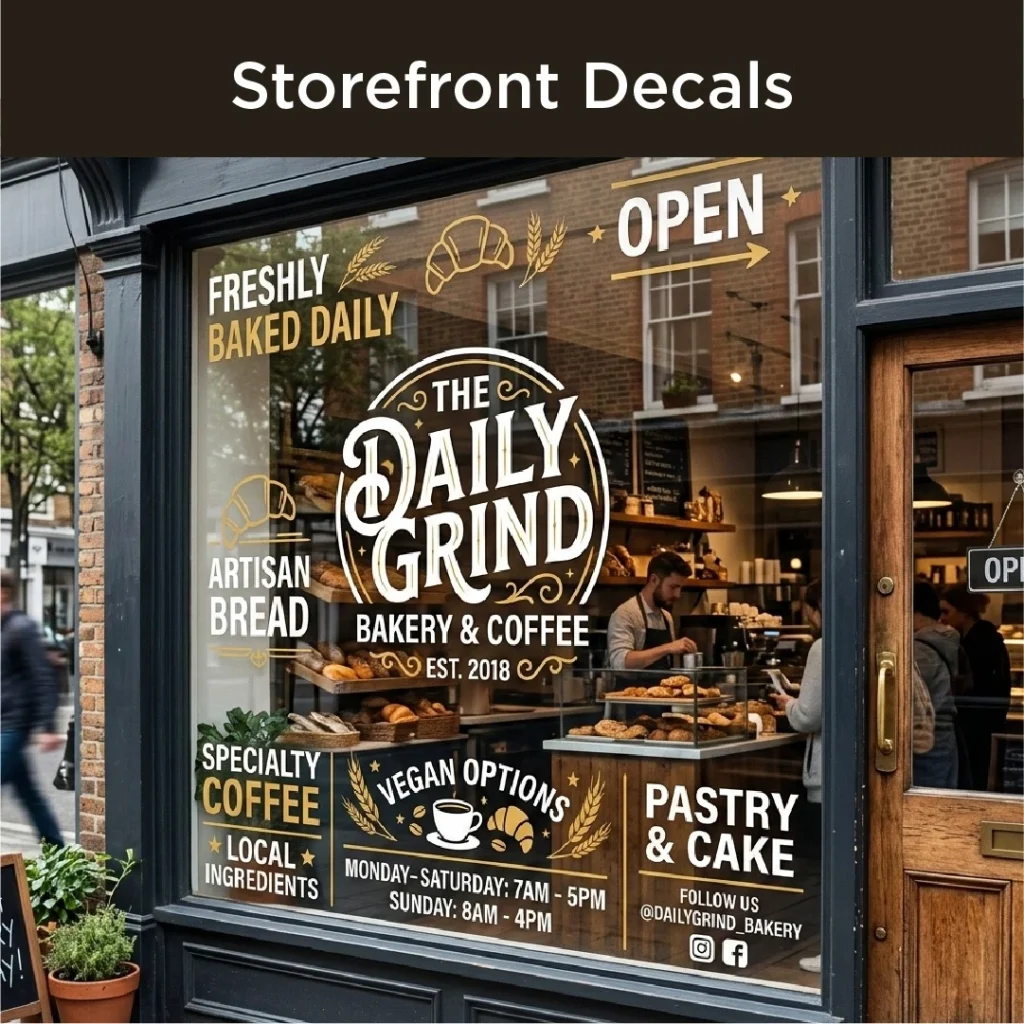
Storefront glass window decals will be essential in displaying products, advertising offers and sharing brand image. They also enable a firm to build a brand name. A window decal design, not only in fonts but also in colors and artwork, also forms the style of your brand and achieves visual harmony. Every inch counts in a brick and mortar store. Wastage of the window space is undesirable.
Although e-commerce is a giant, in-store shopping is extremely popular. Store sales have been on the rise in recent years, and numerous customers are dependent on the combination of online and offline shopping. It is essential to attract the attention of people who pass by the use of custom window signs. The graphics in your storefront window need to make people want to go in, persuade them to visit your site or at the minimum get to know about your brand. Business marketing window decals are simple and efficient means of accessing potential shoppers.
What is the Material of Window Decals?
Adhesive vinyl is used to make window decals. The long-lasting vinyl is 4 mil in depth, and it is matte, which makes your design appear high-end and professional. The permanent bonding material will keep your sign intact to heat, water and abrasion so that you can place your sign indoors or outdoors.
Why Choose Window Decals?
Custom vinyl window decals are striking and simple to use and apply in high quality and durable window signs. The durable vinyl is a durable fabric to show off your design. The adhesive is low tack and therefore easy to remove leaving no residue behind.
Its long-lasting materials ensure that it can be used in the long-term when it comes to signage such as store hours and logos or frequent sales, such as BOGO and discounts on products. These window stickers accommodate one-sided designs. The white vinyl makes all of your graphics and colors visible. Other clean and flat surfaces such as store walls or doors can also be used with custom decals.
Clings to windows are supported by static and they are ideal in temporary signs whereas window perfs are two-way but not entirely opaque.
How to Design Window Decals?
Impression should be made by creative storefront window graphics. The design of your decal on the window must be memorable in terms of designs but must also be consistent with your current branding.
Select fonts, colors and images that are in line with your store and your web site. Meanwhile, make sure that the design does not fade into the background. Photos, artwork and patterns are bold graphics which attract attention, particularly those who are in a hurry.
The glass should be contrasting with the colors. Dark colors can be merged with the window whereas the brighter ones can be more prominent. Colors are made deeper and clearer by the white vinyl base.
Your design must have a single idea. Be it advertising a product, a sale or a brand name, the restriction of a message helps to avoid clutter and enhance clarity.
How Large Should Text be on Window Signage?
The majority of individuals will not take time to read a sign, hence text is minimal. Use bold fonts such as Helvetica or Arial and make sure there is a great contrast.
The size of the text must be proportional to the distance of viewing:
- 2 feet away – Use 5pt text
- 5 feet away – Use 13pt text
- 10 feet away – Use 25pt text
- 50 feet away – Use 125pt text
Which Window Decal Size and Shape is the Best?
Your decal should be of the same size and shape as your design and the space you have. The most common ones are circle, rectangle and square decals.
Small decals are effective to use in store hours at entrances, and large ones are more efficient to be seen at a distance. The most common are 11″ x 17, 16x 20, 24 x 36 and 40 x 60. Other popular formats are square, such as 18″ x 18″ and 30″ x 30″.
The Application and Removal of Window Decals
Decals on windows can be put on clean and smooth surfaces. It should be applied slowly after first aligning the decal and then peeling off the backing. Gently press bubbles in the middle to the edges with a hard surface such as a credit card.
Warm soapy water or glass cleaner can be used in order to loosen the adhesive to remove decals. The adhesive is low-tack, which means that it can be removed without leaving any residue, but it is better to clean the surface after use.
The Value of Window Dresses in your Retail Store
The retail outlets are in high-traffic areas. An effective window display will affect the number of people who pass by and make purchases. Shoppers usually develop their initial impression of an organization by looking at the storefront.
An innovative presentation can be used to promote, showcase products and strengthen brand name. Good window displays transform passers by into customers.
How to get people to walk through your door?
The retail success depends on foot traffic. An attractive presentation is one that will make people pause and listen. There is a role of storytelling. Rather than just putting products there, you can make a scene that appeals to the audience.
Lighting increases visibility. The use of focused lighting and backlighting creates emphasis on major products and gives them depth respectively.
Highlighting Promotions with Window Displays
The displays in the windows can be used to communicate promotions and discounts. Urgent signage is achieved through bold signage. It is important to be placed clearly so that the message is seen at various angles.
Promotional messages can be reinforced with the help of posters, banners, and decals that will direct customers to the offers.
Establishing a Tradeoff between Beauty and Practicability
An effective exhibition is one that is aesthetically appealing and practical at the same time. Avoid overcrowding. Target major products and organize around the products.
The layout is well organized to direct the attention of the viewer and enhances the shopping experience.
The Importance of lighting in window displays
Lighting is used to enhance visibility and atmosphere. Spotlights are used to emphasize products and layered lighting is used to create depth. Adequate lighting makes the displays effective both in the day and night.
Using Smart Display Techniques to maximize small space
Even with limited space, it is possible to achieve good results. Wall-mounted displays, vertical displays, and plain designs are useful in maximizing visibility.
Slim designs that have a single powerful focal point might be as efficient as complicated designs.
The Signage in Retail Stores
Signage will determine the way that customers will experience a retail space and affect behavior.
Well-planned signage can:
- Increase foot traffic
- Build brand recognition
- Affect buying behavior
- Encourage impulse buying
- Enhance customer navigation
- Offer affordable marketing
Forms of Signage in Retail Stores
Outdoor advertising: storefront signs, window decals, banners, and flags.
Internal signage: directional signs, information display and point-of-sale signage.
Advertising materials: posters, shelf talkers, and event signs.
Digital signage can easily be updated and dynamic and it can be used to keep the content fresh in a business.
How to Design Retail Signage?
- Design and structure: Put emphasis on important messages first.
- Typography: Simple, easy to read fonts.
- Color and contrast: Be seen at a distance.
- Brand consistency: Have a consistent appearance.
- Accessibility: Designs need to be visible and understandable to all customers.
Signage Materials at Retail Stores
Some of the typical materials are vinyl, foam board, acrylic, coroplast and PVC board. The option would be based on whether one needs an indoor or outdoor sign and the duration required.
Signage Best Practices and Tips
- Place signs at eye level
- Locate them at strategic decision points
- Avoid overcrowding
- Apply floor and ceiling signs where necessary
- Confirm local requirements prior to installation
Conclusion
Retail store signage is a powerful means of attention, direction, and assisting sales. Existing space is used to communicate in a clear and consistent way with window decals and displays.
Considerable design, location, and materials can enable businesses to enhance visibility and customer experience without significant structural modifications. Revising and improving storefront displays may result in improved interaction and improved outcomes.
Frequently Asked Questions
Q#1. What are window decals composed of?
Adhesive vinyl is normally used to create window decals that are strong and resistant to weather, heat and moisture.
Q#2. Do window decals come off easily?
Yes, the majority of decals are low-tack, which means that they can be easily removed without leaving any traces.
Q#3. What is the distinction between window clings and window decals?
Window decals are adhesive based and window clings are better in the case of temporary use as they are based on statics.
Q#4. What is the life of window decals?
Exterior decals can last one to three years depending on the exposure, whereas interior decals can last longer.
Q#5. Are window decals able to block natural light?
The opaque decal prevents light and perforated and frosted designs permit light to enter.