
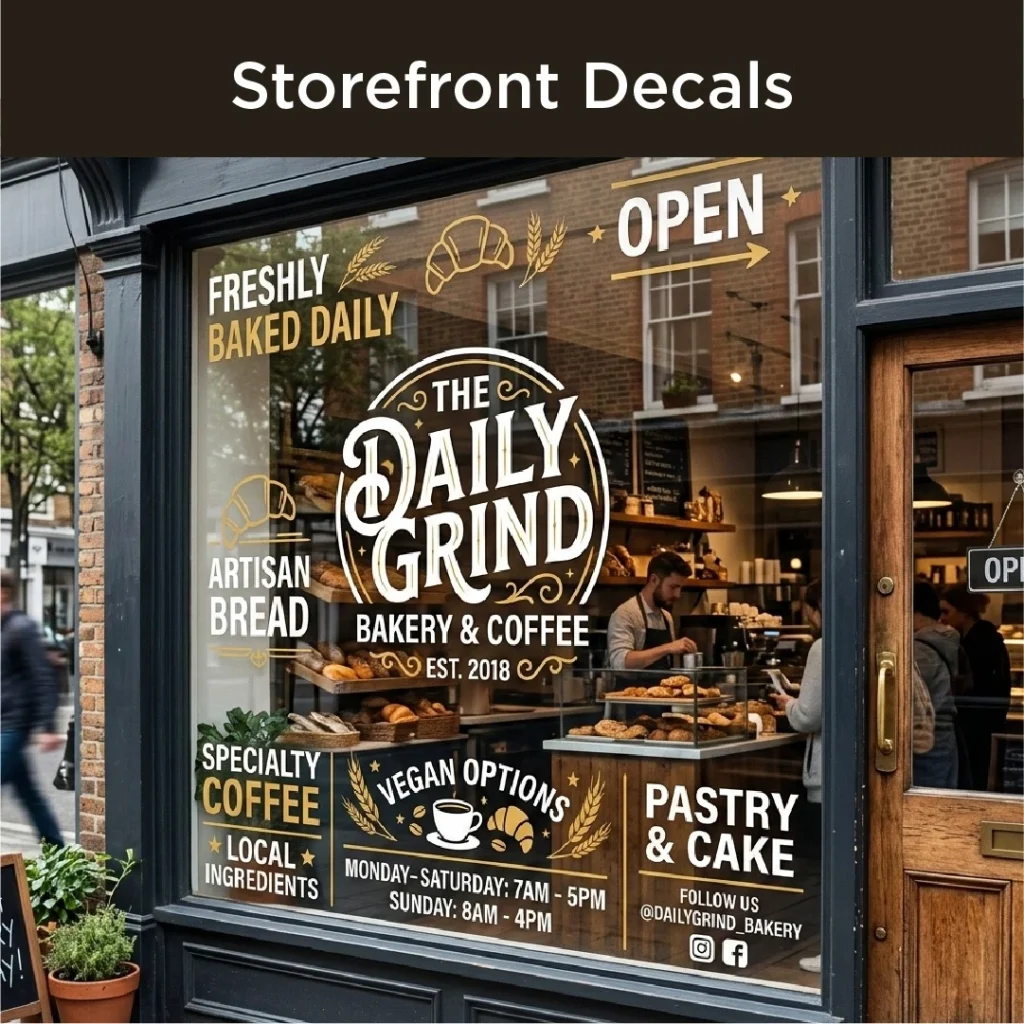
Storefront decals and stickers are used to assist businesses in enhancing brand recognition by transforming windows, glass doors, and other visible surfaces into a communication medium. These visual graphics are used to show logo, business information and promotion messages on glass without altering the structure of the building. Storefront decals can enhance visibility, brand recognition, and convey the necessary information to customers when they pass by the storefront when placed in the right manner and designed in a clear way.
Visual communication is a critical part in the contemporary retail setting in capturing attention and directing potential customers. Storefront decals offer an easy and versatile way of displaying the brand messages without obstructing the open look of the storefront.
Knowing Storefront Decals and Stickers
Custom stickers and decals are stickers and decals that are adhesive graphics that are used to adorn surfaces like glass, vehicles, packaging, and walls. They are most frequently used in retail settings on windows of stores and on glass doors.
Stickers and decals have minor differences even though they have comparable functions.
The stickers are usually created on paper or vinyl material and are usually used in short term promotions, labeling or decorative purposes. Decals are made generally of more robust vinyl materials and are made to last longer especially in outdoor settings.
Due to its durability, decals are commonly employed by businesses to brand their stores, do window signs or permanent displays.
These graphics convert idle areas of glass to an informational surface that conveys branding and messages without the use of structural signage.
Of Why Storefront Decals Strengthen Brand Identity
A robust brand identity requires a consistent visual image in all the touchpoints of the customers. Storefront decals are used to reinforce this objective by placing familiar brand components in high-traffic locations.
Visual Recognition
Brand familiarity is strengthened by logos, colors and typography in decals. The more customers are exposed to these aspects, the more they are likely to remember the brand.
Continuous Visibility
In contrast to most advertising techniques, the window decals can be seen all day long. The storefront even when the store is closed keeps communicating brand identity to individuals who walk or drive past the store.
Clear Communication
Decals enable companies to put critical information about their store hours, promotions, contact details, or product features. This knowledge can enable the customers to gain an immediate idea of what the business is about.
Storefront Appearance Professionalism
A storefront graphic layout is well organized to give it a professional look. Clear and uncluttered images simplify the identification of the business and make it more friendly to the customers.
Graphical Effectiveness and Designability
The great visual effect and flexibility in design are also one of the primary benefits of storefront decals.
Depending on their branding strategy, businesses can experiment with shapes, sizes and layouts. Decals may be printed using bright colors, plain lettering or complete graphic design.
Decals can fit any brand identity since they can be created in various forms. Other businesses are fond of simple designs which display a logo or store hours. There are also those who employ bigger graphics as a means of emphasizing seasonal offers or products on display.
This is flexible enough to enable businesses to have a consistent branding and adjust messages where needed.
Storefront Window Decal types
There are various types of retail storefront decals, and each is created according to the needs of communication and visibility.
Clear Window Decals
Transparent vinyl material is used to print clear decals. The design is only printed on the glass with the background being transparent.
The applications of these decals include logos or store hours since they are visible within the store.
Opaque Window Decals
Opaque decals involve solid vinyl materials which do not allow one to see through the glass. They produce a good visual contrast and are mostly applied to large promotional graphics or advertisements.
Perforated Window Decals
Perforated decals have tiny holes that are scattered all over the vinyl surface. Outwardly, the viewers observe the printed graphic. The window still allows people in the building to see through.
This design is common when advertising in the store front in which interior visibility should be functional.
Frosted Window Decals
Frosted vinyl looks like a sandblasted or etched glass. It also gives privacy and allows the natural light to get into the space.
Frosted decals are normally applied in offices, meeting rooms, clinics, and reception.
Vinyl Window Decals
One of the most popular types of window graphics is a vinyl decal. They are tough, weatherproof and can showcase complicated shapes or designs.
Due to its durability, vinyl decals are often employed as outdoor storefront signs.
Storefront Decal Cost Effectiveness
Storefront decals are usually cheaper than conventional signage.
Big sign boards may need to be fabricated, may need to be installed with hardware and may even need a permit. On the other hand, window decals are based on the use of adhesive materials and already available glass surfaces.
This benefit of costs makes decals particularly helpful in small businesses, new retailers or businesses that change promotions frequently.
Since decals are easy to change, companies are able to change marketing messages without having to change permanent signage.
Storefront graphics Design Principles
To enhance brand identity, it is important to have clear design principles to be used in storefront decals.
Clarity and Readability
Storefront graphics is mainly aimed at communication. The text should be big enough to be read even when one is standing far away, especially when the pedestrians or drivers are going to the store.
Font Selection
Basic and plain fonts are readable compared to ornamented types. Storefront graphics are usually done using Sans serif fonts due to the ability to read them at a distance.
Color Contrast
High contrast of text and background enhances readability. Dark lettering on light backgrounds or light lettering on dark backgrounds is likely to be the most readable combination.
Simplicity
Excessive information may decrease the legibility. Good storefront graphics normally show the most vital information like the name of the business, business logo or a short message.
Combining Storefront Decals and the General Brand Identity
The storefront decals must be in line with the overall business branding.
Storefront signage, packaging, marketing materials and digital platforms should be the same in terms of brand colors, logos and typography. This uniformity assists the customers to identify the brand in various settings.
The target audience should also be reflected in the design style. Companies that target families can employ vivid colors and fun illustrations. Companies that are aimed at a high-end market can afford to apply little designs and low color schemes.
The uniformity of the visual elements enhances brand recognition and brand identity.
Storefront Signage Materials
However, although decals are commonly used on glass, permanent signage is commonly done on other materials.
Metal signage is durable and has a contemporary look. Wood signs have an old fashioned appearance and they need care. Acrylic signage is versatile and moderately durable. Stone signage is costly and cumbersome and gives a sense of permanence. PVC signage is moderately priced and has a decent life span.
The materials are available in varying benefits in terms of budget, weather, and brand image.
Placement and Visibility Concerns
Storefront graphics are largely dependent on placement.
The signs and decals are to be placed in the areas where they can be seen by both pedestrians and vehicle traffic. Eye level positioning is good with the pedestrians whereas elevated signage is good with the drivers.
The visibility is also enhanced by lighting, especially at evening time. It is common to use LED lighting to maintain a constant visibility during the day and night.
Businesses should also make sure that the signage is not blocked by trees, awnings or buildings.
Conclusion
Storefront decals of the retail stores are significant in enhancing brand identity and storefront communication. Through the available glass surfaces, businesses will be able to display transparent branding, offers and the necessary information without significant structural alterations.
Decals can be used as effective communication tools when they are made clear, have a proper contrast, and contain the same branding elements that can be seen throughout the day.
A business that considers good design and location can utilize storefront decals to develop a familiar visual image and keep a professional presence in competitive retail settings.
FAQs
What do retail storefront decals do?
Storefront decals are used to brand the retail stores by placing logos, store hours, promotional messages and decorative graphics on glass windows and doors.
Are there storefront decals that are durable when used outdoors?
Yes. Outdoor vinyl decals of high quality may last several years under the weather and maintenance conditions.
Are storefront decals harmful to glass surfaces?
Majority of the decals are removable and they do not cause harm to glass when removed in a proper manner.
Are storefront decals appropriate to small business?
Yes. Storefront decals are a low cost marketing strategy that enables small businesses to put up branding and marketing messages without necessarily spending on permanent signage.
What are the design characteristics that enhance storefront decal visibility?
Storefront graphics should be made easier to read and see with clear fonts, high color contrast, large fonts, and simple layouts.