Deprecated: Non-canonical cast (double) is deprecated, use the (float) cast instead in /home/decalsdepot/public_html/wp-content/plugins/easy-table-of-contents/includes/vendor/ultimate-web-scraper/tag_filter.php on line 2922
Deprecated: Non-canonical cast (double) is deprecated, use the (float) cast instead in /home/decalsdepot/public_html/wp-content/plugins/easy-table-of-contents/includes/vendor/ultimate-web-scraper/tag_filter.php on line 2926
Deprecated: Non-canonical cast (double) is deprecated, use the (float) cast instead in /home/decalsdepot/public_html/wp-content/plugins/easy-table-of-contents/includes/vendor/ultimate-web-scraper/tag_filter.php on line 2927
A storefront can be the initial contact between a business and the society. Storefront decals, also called window graphics, are a convenient and flexible way to enhance visibility, convey valuable information, and enrich the visual appearance of a building. In addition to decoration, these graphics also have functional purposes such as branding, privacy, promotion, and spatial design.
This article discusses the uses, design, materials, types of installations, and the long-term value of storefront decals in the business world.
What Are Storefront Decals?
Storefront decals are vinyl graphic stickers that are used on glass surfaces like windows and doors. They are as simple as lettering and logos and as elaborate as complete window coverings and printed pictures. Decals can be either temporary or permanent depending on the type of adhesive used and the purpose.
Decals are easy to update or change in comparison to permanent architectural changes. This adaptability enables companies to change branding aspects, alter business data, or add seasonal images without changing the structure.
Retail areas, restaurants, offices, medical centers, fitness centers, and service-oriented businesses are typical users of storefront decals. They are not purely decorative. They serve as means of communication, brand recognition, and privacy solutions, as well as add to the aesthetic of commercial areas.
Applications of Storefront Decals
Enhancing Privacy
Companies that are located on the street and have their windows facing the street usually need privacy without compromising natural light. Frosted vinyl, etched designs, and patterned graphics minimize interior visibility without reducing brightness. This design is popular in health care facilities, salons, studios, and professional areas where confidentiality is required.
Another solution is perforated vinyl. It lets those indoors look out without letting those outside look in, providing one-way privacy without obstructing the light.
Business Identity and Branding
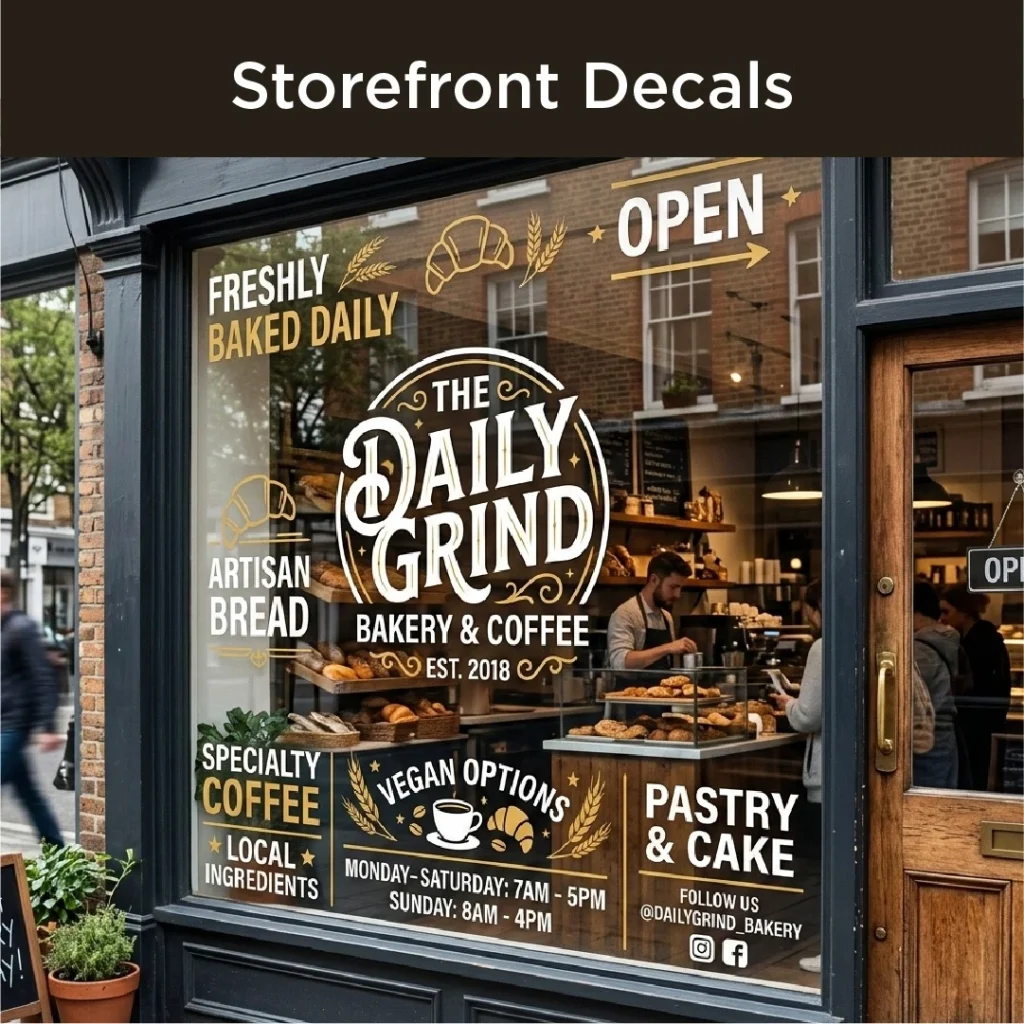
A storefront decal can also be used to strengthen brand identity by showing a company name, logo, tagline, services, contact information, and hours of operation. Typographical consistency, color choice, and layout enhance recognition and aid visual consistency on physical and digital platforms.
Clarity in presenting key information including:
- Business name
- Logo
- Hours of operation
- Contact information
- Website address
- Social media identifiers
is a way of making sure that the people who pass by quickly get to know what the business is about.
Advertising Sales and Services
Window graphics are often used to emphasize limited-time deals, seasonal offers, new product launches, or service announcements. Since it is not hard to remove or replace decals, they enable businesses to change messaging as needs evolve.
Good promotional decals are readable. The use of high-contrast lettering and limited words makes sure that information is received by pedestrians or passing vehicles within a few seconds.
Community and Seasonal Displays
Holiday, community, and local events can be marked with temporary window graphics. Seasonal displays make storefronts visually up-to-date and show engagement in community life. Such updates may be indirect, like decorative motifs, or more direct, like announcements related to particular dates.
Frequent visual transformations also ensure that storefronts do not look static, keeping people interested in the long run.
Artistic and Environmental Contribution
Good quality window graphics can add to the personality of a neighborhood. Blank glass surfaces can be converted into aesthetically pleasing features through murals, patterned films, and illustrative designs. In certain districts, coordinated window designs improve the overall beauty of commercial corridors.
Emphasis on Products and Services
Window decals are commonly used by businesses that deal in particular products or types of services. Cafes can display images of beverages, salons can refer to styling services, and bakeries can depict baked goods. These images give instant context and minimize confusion for prospective customers.
Storefront Decals Design
Material Selection
Durability, appearance, and functionality depend on material choice. Common options include:
- Clear vinyl for minimal visual obstruction
- Opaque vinyl for full coverage
- Frosted film for privacy with light transmission
- Perforated vinyl for one-way visibility
- Temporary clings
Material choice should be determined by the desired duration of the graphic and environmental exposure.
Placement and Visibility
Positioning enhances effectiveness. Important information like logos and working hours is usually located at eye level. Designers take into consideration pedestrian flow, traffic direction, window size, and sightlines so that graphics can be seen from various angles.
The height of lettering should match the viewing distance. Graphics that are to be read from across a street or parking lot need larger text.
Simplicity and Readability
Window graphics should communicate quickly. Text should be restricted to short phrases to enhance understanding. High contrast between text and background helps increase readability, especially in different daylight conditions.
Maintenance and Longevity
Regular washing using a soft cloth and mild detergent helps avoid dirt accumulation and maintain clarity. When removal is required, proper methods ensure there is no residue and that the glass remains intact.
Graphics exposed to sunlight, water, and temperature fluctuations might need stronger adhesive formulations than those used in interior applications.
Storefront Window Graphic Types
First Surface Graphics
First surface graphics are applied to the outside of the glass with the printed design facing outward. They can be attached to transparent or non-transparent surfaces.
Characteristics:
- Adhesive on the back of the print
- Straightforward installation
- Easier removal
- Applicable on opaque surfaces
Second Surface Graphics
Second surface graphics are mounted on the inside of the glass but face outward. The image is usually mirror-printed to make sure that it is oriented properly.
Characteristics:
- Shielded against exposure to weather
- Adhesive on the front of the print
- Increased durability
- Requires transparency for visibility
Temporary Graphics
Short-term window graphics are temporary in nature. These include:
- Clings that rely on static charge instead of adhesive
- Low-tac decals using light adhesive for repositioning
They can be used in seasonal promotions or frequent message changes.
Long-Term Graphics
Permanent graphics involve stronger adhesive formulations to fix logos, hours, and branding elements for long-term use. This type includes high-tac vinyl and permanent window stickers.
Window Coverage Styles
Full Window Wraps
Full coverage designs transform entire glass surfaces. Options include:
- See-through graphics that allow outward visibility
- Perforated film with one-way viewing
- Opaque film that blocks visibility
These styles balance aesthetics and functional requirements like privacy or light control.
Vinyl Lettering
Essential information like business hours, contact details, and lists of services is usually displayed using vinyl lettering. Letters are cut individually from solid-colored vinyl and adhered directly to the glass, giving a clean and minimal look.
Contour and Die-Cut Decals
Die-cut decals are cut to the exact shape of logos or graphic outlines. They do not require a background panel, preserving open window space while emphasizing specific details.
Cost Factors
Storefront decal cost is determined by:
- Design complexity
- Size and coverage area
- Material selection
- Installation requirements
- Quantity of graphics
Complex multicolor prints and large installations usually cost more to produce than plain lettering or small decals.
Sustainability and Technological Developments
Technological Integration
Developments in printing and materials have increased design possibilities. More complicated visual presentations are made possible through double-sided graphics, transparency effects, and specialty inks.
Sustainability in Design
Eco-friendly production processes are increasing. These include:
- Water-based and eco-solvent inks
- Recyclable or low-impact vinyl materials
- Minimal-waste printing methods
These practices reduce environmental impact while maintaining durability and visual clarity.
Conclusion
Storefront decals are a versatile and convenient way of turning business windows into effective communication tools. They support branding, enhance privacy, emphasize services, and contribute to the surrounding environment. Storefront decals can be used aesthetically and functionally with careful attention to design, material choice, placement, and upkeep.
Planned window graphics in competitive business settings enable companies to convey clear information, remain visually relevant, and adapt to business needs without permanently altering the structure.